
Your Guide to Common Dental Procedures Part 2
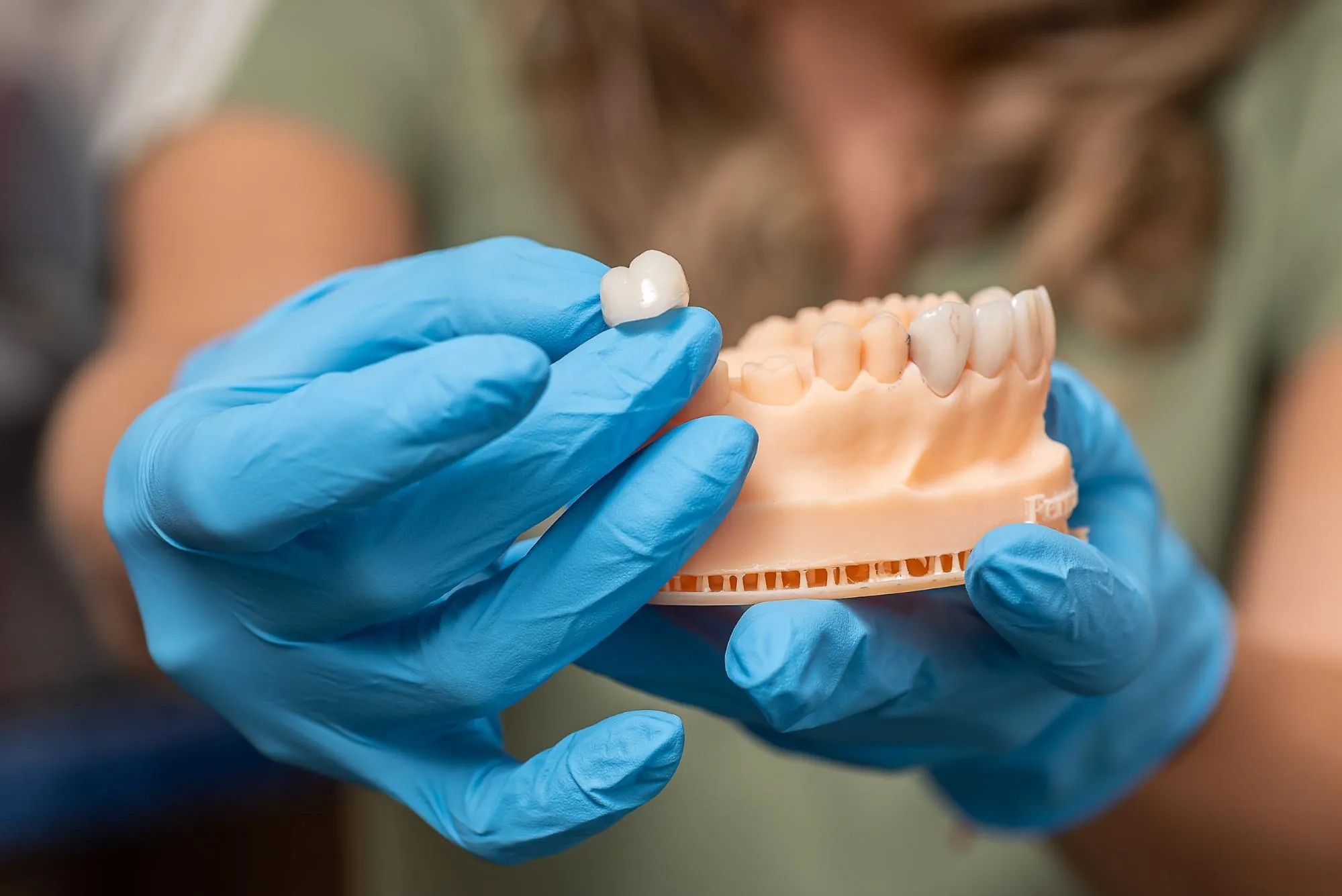
We discussed implants in part one of our Guide to Common Dental Procedure Series, so it only makes sense to talk about crowns next. In simplest terms, a crown is an artificial tooth. There are two basic types: one that is made to replace one that you have lost, and one that covers a weak or damaged tooth.
In some cases, if you have a broken tooth that needs strengthening, a crown will be created to fit over it and provide protection and support.
What is a Crown?
A crown is an artificial tooth created to replace a damaged or missing tooth. If your tooth has a healthy root but the enamel is cracked or damaged, a crown can be made to fit over the damaged tooth.
Crowns can be used for cosmetic reasons if the natural tooth is unsightly. They can also protect the structural integrity of a tooth weakened by a root canal or large fillings. Left untreated, this tooth can break when you chew hard foods or grind your teeth at night.
In the case of a missing tooth, a crown can be attached to a titanium or zirconium implant to maintain your smile's form and function.
Procedure 1: Abutment Crown
When It's Used
The term abutment crown is misleading because it isn't actually a crown. It is the metal piece that connects the post implanted in your jaw to the artificial tooth. An abutment crown is used when a dental implant has an attached crown.
What is Involved
The crown abutment is attached to the post right before the crown as part of the same procedure. The abutment is the shiny metal piece above the screw and below the crown.
How Long Does It Take?
The placement of abutment crowns is generally done during either the surgical or final visit, so it does not significantly add time to the procedure.
Cost Comparison
In the US, an abutment crown can cost between $700 and $2,000, compared to $750 in Costa Rica or Mexico.
Procedure 2: Porcelain, Emax, and Zirconia Crowns
When It's Used
Porcelain crowns are inexpensive options made from white ceramic that mimic the look of natural teeth. They have been around since the late 1800s and were a good option for people allergic to metal. They are used for crowns over natural teeth.
Zirconia is a ceramic material made from zirconium oxide that is hard and durable. It is white, acid-resistant, and smooth enough to prevent bacterial plaque formation. It can also be used over natural teeth, and is the preferred material for bridges in the back of the arch.
Emax is a brand name for lithium disilicate. This highly durable glass-ceramic material is more robust than your natural teeth and, therefore, less likely to chip or crack the way a traditional porcelain crown would. The material is also slightly translucent, just like your natural enamel, and can be tinted to match your existing teeth.
What is Involved
The natural tooth must be filed and cleaned, and then an impression of the tooth is made. Once created, the crown is carefully painted or detailed to match the neighboring teeth. To make a crown that fits precisely, we take digital scans of your teeth and a physical mold as references, and our artists ensure your crown blends seamlessly with your smile.
How Long Does It Take?
Modern technology allows us to design digitally and mill porcelain blocks in our laboratory. That means you can have a porcelain crown in as little as three or four days. If you already have the implants, are getting a crown placed on an existing tooth, or require a replacement crown, they can be made within 3 - 4 days.
Cost Comparison
In the US, a porcelain crown can cost between $800 and $3,000 per tooth. In Costa Rica or Mexico, that price is $500. One Emax dental crown can range from $1,100 to $1,500 in the US, while a zirconium crown can cost up to $2,500, compared to around $600 in Costa Rica.
Contact us today to schedule a free consultation and embark on your transformative journey!
Procedure 3: Pontic Emax
When It's Used
Pontic Emax is when an artificial tooth made from Emax (a brand name for lithium disilicate) is attached to crowns on both sides of a missing tooth to replace it. This creates a structure similar to traditional bridges but much more durable.
What is Involved
A pontic Emax is a series of crowns fabricated as a single unit from Emax material. Because the material is solid and the bridge is fabricated as a single piece, it is incredibly durable and much less likely to break or crack while chewing than a traditional bridge. Scans and molds of your teeth will be taken, and those scans will be the basis for a digital design. The bridge is then milled from a single block of lithium disilicate and colored to match the rest of your smile.
How Long Does It Take?
Four or fewer crowns can be completed in 3 - 4 days, and any more than that can require a week to produce. When the crowns are part of a Pontic Emax, you can expect three separate visits: one to take impressions and shave the teeth that will receive the crowns, one to fit and deliver them, and one final visit to adjust the bite if necessary. Overall, this usually takes one week from Monday to Saturday.
Cost Comparison
In the US, the price range for a 3-crown bridge is $3,500 to $6,000, whereas in Costa Rica, it ranges from $1,500 for a porcelain ceramic crown to $1,850 for a Zirconium Crown.
Procedure 4: Temporary Reinforced Dental Crown
When It's Used
Creating a dental crown involves filing down the natural tooth so the crown fits over the top. Also known as a provisional or interim crown, a temporary reinforced crown is created to protect the tooth that has been filed down while the permanent crown is being made. Teeth with a filling can also be more sensitive to temperature changes, so a temporary crown will reduce access to the root and help prevent discomfort.
What is Involved
Your tooth must first be filed down to its final size and then cleaned. Then, an impression is made using dental paste or putty. Our lab technicians create the temporary crown using acrylic-based plastic and attach it using temporary cement, which will be removed later.
How Long Does It Take?
A temporary crown usually takes less than an hour to make.
Cost Comparison
The average cost of a temporary crown in the United States is $450, compared to $100 in Costa Rica or Cancún.
Procedure 5: Crown Build Up
When It's Used
Before a crown can be placed on an existing tooth, we must ensure the tooth is healthy. If it is unhealthy, we build it up using a process known as Crown Buildup.
What is Involved
If the tooth already has a cavity or an older filling, we will remove the filling and any damaged structure, clean it, and replace it with composite resin to create a strong core for the crown to rest on and be attached to.
How Long Does It Take?
This process is relatively quick and painless. The procedure should take less than 30 minutes.
Cost Comparison
In the US, this procedure costs between $350 and $750. In Costa Rica or Mexico, that cost is between $85 to $150 per build-up.
Thinking About Getting Crowns?
Now that you know what crowns are, how they are used, and what they cost, feel free to contact us for a free estimate. If you need a crown, call us toll-free from Canada and the US at 1-(877)-337-6392. Our friendly English-speaking staff is ready and waiting to answer your questions.